

A note from our COO on what’s really happening across accounting and finance teams right now—and what it means for you.
By: Jennifer Spaulding-Marsh, Chief Operating Officer | trak group
If you’re working in accounting and finance jobs in Cincinnati in 2026, you probably don’t need a market report to tell you something has shifted.
You feel it every month-end. You see it in your inbox. You carry it in your workload.
Over the past two years, many finance teams have stayed lean. Open roles weren’t always replaced. Responsibilities expanded. Systems changed. Reporting demands increased.
And most teams just… absorbed it.
If your job feels broader than it did 18–24 months ago, that’s not a personal productivity issue. It’s a market pattern.
What We’re Seeing Across Accounting & Finance Jobs in Cincinnati
In conversations with professionals across Greater Cincinnati, a few themes keep surfacing:
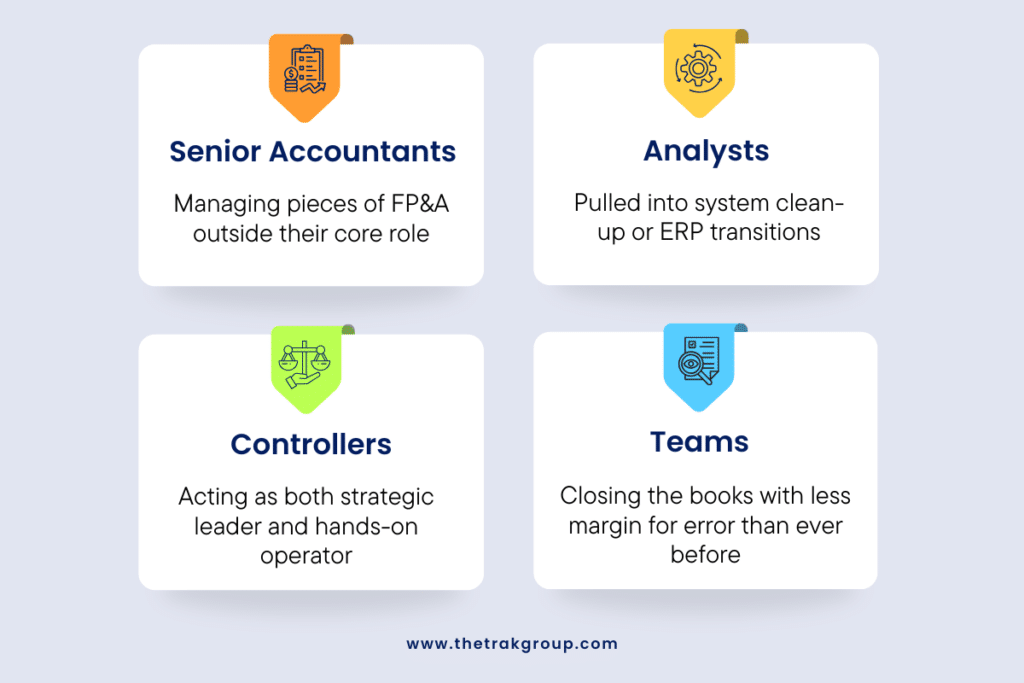
The expectations didn’t decrease. The headcount often did.
Many high performers are now carrying 1.5 roles—and doing it well enough that leadership may not fully see the strain.
The Hidden Risk of Being the “Reliable One”
If you’re the dependable, high-output person on your team, there’s a unique challenge: you become the default problem-solver.
You know the work. You know the systems. You know the history. So more gets routed to you.
Over time, that can lead to:
- Title stagnation
- Limited strategic exposure
- Burnout masked as competence
- Being indispensable in execution, but overlooked for advancement
It’s not malicious. It’s structural.
What the Cincinnati Accounting & Finance Job Market Is Rewarding Right Now
Here’s the encouraging part.
The professionals gaining traction in 2026 aren’t just technically strong—they’re visible in how they improve processes. The market is valuing accountants who:
- Shorten close timelines
- Automate manual reporting
- Improve forecast accuracy
- Clean up messy reconciliations and leave them better than they found them
- Speak confidently about business impact, not just debits and credits
Technical skill is assumed. Operational impact is what differentiates you.
If You’re Feeling Stretched, Ask Yourself:
- Has my scope quietly expanded?
- Am I still learning, or just maintaining?
- Does my current role position me for the next title I want?
- If I stay here 18 more months, will my trajectory improve—or plateau?
These aren’t “you should leave” questions. They’re clarity questions.
The accounting market isn’t frantic right now—but strong professionals still have options. Especially those with 5–10 years of experience who can bridge technical execution and business thinking.
You’re Not the Only One Thinking About It
Many accounting professionals I speak with aren’t actively job searching. They’re just assessing.
They want sustainable workload, a clear advancement path, strong leadership, hybrid flexibility where possible, and work that builds toward something.
If you’ve found that—protect it.
If you haven’t—it may be worth understanding what the market actually looks like before you assume it’s “the same everywhere.”
Accounting and finance roles have always carried responsibility. That hasn’t changed.
But if the weight feels heavier right now, you’re not alone—and you’re not misreading it.
Let’s Compare Notes
If you’d like an honest, no-pressure conversation about what we’re seeing across the Cincinnati market— compensation, structure, growth paths—I’m always happy to talk.
